Showing posts with label Montessori. Show all posts

Friday, April 3, 2009

Recommended Home Pre-School Books

Teaching Montessori in the Home: The Pre-School Years, by Elizabeth B. Hainstock
This was the first Montessori book I read and would recommend it as a good starting point for those new to Montessori. It is a short easy read that is not overloaded with too much Montessori information which can sometimes be overwhelming.


Montessori Play and Learn: A Parents' Guide to Purposeful Play from Two to Six, by Lesley Britton
Also a good introduction to the Montessori Method. The first half of the book would actually be good reading for all parents in general. It covers the importance of the role of the parent in the development of their children. It also offers good suggestions on how to make your home more child-friendly.


Montessori: A Modern Approach, by Paula Polk Lillard
A good book if you are interested in more in depth reading of the Montessori approach. Not technically ‘modern’ since it was written many years ago. However, the Montessori method hasn’t changed since, so this book still applies today.


By the way, I found all of these books at our local library. I would suggest visiting a library and browsing through their collection of books in the subject. The library has been a great resource for me. Something I recently learned is that if my local library doesn’t have a book I need, I can request it and they will borrow a copy from another county library. I then get an email when the book arrives. How convenient!

Wednesday, April 1, 2009

Home School Chronicle – Productive Tuesday

Tuesday was a very productive day in class (I know, I’m a little behind). It was our first day back in class after four days off so the kids were eager to enter the classroom. You will notice that our classroom doesn’t have typical Montessori materials. There are so many great materials that I wish I could have available for CC and RJ, unfortunately purchasing pricey Montessori materials is not in our budget at the moment. So I’ve had to get creative. Here are some of the activities CC and RJ worked on.

After an extra jolly and musical rug time, CC first chose to work on my version of the Spindles Activity. THIS is a description of a typical Spindle Box and its function.
Ours is not so much a box with compartments and has pencils instead of spindles, but it still serves its purpose. CC usually likes to work on this activity together, however today she pulled it out and worked on it correctly all by herself=).

Here is a close up of the box. To make this box, I cut down and resized a larger cardboard box, cut out the openings and wrapped the box with the brown paper (left over painter’s roll). The cylinders are cut from a roll that our ‘Rug Time’ rug was wrapped around. All the materials needed were found around the house, I only had to purchase the pencils so the total cost of this activity was $3.

After watching CC work on the Spindles for a while RJ chose to work on the Bowl of Clothespins. This activity is meant to help with fine muscle control and strengthens the three finger grip. You’ll notice that there are numbers in the bowl. This is not necessarily Montessorian but I added the numbers to give CC an extra challenge when she chooses this activity from RJ’s shelf. When CC works on this activity she clips the clothespins in numerical order while saying the numbers out loud.

Here is CC working on a Color Sorting activity. CC completes this activity using tongs very easily. I have been trying to work on colors with RJ, but he still does not show much interest in sorting by color. The tongs aren’t available for RJ with this activity, when he works on this activity he uses his hands to randomly place the small toys in the compartments.

This Coins In the Bank activity is very simple, but RJ and CC both like it. You can see how much RJ focuses on this picture. RJ repeated this activity a number of times before moving on. When CC works on this activity she tries to name the coins out loud. Although she still doesn’t quite understand the value of money, she is learning the difference between quarters, dimes, nickels and pennies.

I have been thinking about removing this shape sorting activity because it has been ignored lately, but I recently added the blindfold to help CC work on her sense of touch. It is going well, so this activity will get to stay in the classroom a few more weeks.

After CC and RJ got a little distracted and had some fun blindfolding each other I suggested that they do one more activity before ending class. CC chose to cut paper and as usual RJ joined her. CC’s cutting is improving while RJ doesn’t yet have the hang of it. I also just noticed on this picture that he was cutting with his right hand... RJ is left-handed. That reminds me, I need to go out and find some left handed toddler scissors.

We usually end our class session by reading some books. On this day we read the latest issue of Little Kids National Geographic. This is such a cute toddler magazine designed for three to six year olds. CC gets excited when it arrives in the mail.
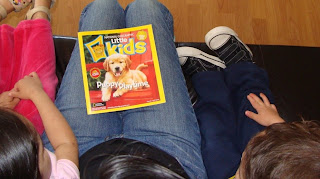
Here is a peak at one of the activities found in this issue which helped CC practice on Sounds. RJ doesn’t know letters yet but he enjoyed pointing to the animals that CC named. I would highly recommend this magazine.

Wednesday, March 25, 2009

Home School Chronicle – Sunflowers and Daisies need water

As much as I enjoy flowers I don’t have an ounce of a ‘green thumb’, so I am starting small. The kids and I are attempting to grow two tiny flower pots of Daisies and Sunflowers (found in Target’s dollar section). Our goal is to eventually plant them outside and hope they bloom. We had a minor setback… we found a very sad looking sunflower pot in the classroom this morning.
“This is what happens to flowers when they don’t get watered”, was today’s first lesson. It actually looked worst when we found it. The picture above was taken about an hour after it was watered, none of the stems were pointing up this morning. Our sad surprise made CC a little upset but she quickly suggested that we give it water QUICK. Thankfully, the sunflowers seem to be making a recovery.
Today we had a productive short class session since we had a pediatrician appointment to get to in the early afternoon. Here are some of the highlights.

RJ spent quite a bit of time working on a Practical Life pasta pouring activity from CC’s shelf. You can see that not all of the pasta stays in the cups but he really enjoys this activity and doesn’t seem to mind cleaning up with a little encouragement.

CC is working on my version of a Sensorial geometric shapes activity. The wooden shapes are part of a small puzzle that I found in the toy clearance section of Cost Plus World Market. I made the pattern cards by hand with colored pencils. For the last three weeks it has been one of CC’s favorite activities and it cost less than $2! Here is a close up of the cards.
CC & RJ ended our class time at the organ. They hadn’t touched the organ in some time but today they both had fun making music for mom.

Friday, March 20, 2009

Our Montessori Environment - The Kitchen

Soon after I started reading about Montessori education I learned that it is not just about what is done in the classroom environment, where my children only spend a couple of hours a day, four to five days a week. I have since made changes to the rest of our home environment as well.

I started with the kitchen where we seem to spend the majority of our time each day. Pre-Montessori, both of my children used highchairs for meals, coloring, and other potentially messy activities. Now, they have the option to dine on their own small table and they love it. I wasn’t too sure about setting up a separate table for them because I prefer that the whole family eats together at the same table. So now we change it up… when it’s just the three of us I sometimes pull up a little chair and join them for meals. Once my husband is home, the kids usually eat at their table while dad and I eat at the regular table not far from them. We’ve kept the highchairs around so they sometimes still use them when they feel like sitting next to mom and dad. Where they eat, is up to them.


There have been other changes in the kitchen. Instead of it being “mom’s kitchen”, it became “our kitchen”. CC and RJ now help with what they can. Depending on the menu, they may help me with meal preparation and they are very good about clearing the table when they are done eating. They now have their own drawer in the kitchen which stores their dishes and utensils. Below is a picture of CC and RJ getting items out of their drawer. They usually ask me what we will be eating to determine if they will need a plate or bowl and a fork or spoon.
Here is a close up of CC and RJ’s drawer. I know the plastic dishes aren’t very montessorian. I have been shopping around for new dishes for them, but have not found the right ones just yet.

Another small but important addition to the kitchen are two prayer frames. The kids and I include prayer throughout our day. In the kitchen, for example, we have our Morning Player and our Mealtime Prayer. The mealtime prayer frame can be seen on the picture of the kids’ dining table. CC and RJ can’t read yet but having the frame next to the table reminds us to pray before our meals. Below is a close up of our Morning Prayer frame.


You might be thinking that the kitchen is an odd location for a morning prayer. I used to try to remember to pray with my children when waking up in the morning. However, CC and RJ don’t always wake up at the same time and praying is something that I want us to do together, plus some mornings can be hectic and we would often forget. The kitchen, however, is where we have breakfast every day. The first thing I do when we walk into our kitchen is open the blinds to the kitchen window, so that is where I placed the Morning Prayer frame.

On a side note:
Starting our Montessori journey hasn’t only made changes to our environment. I feel that it is also improving my parenting style. I have a better understanding of CC and RJ’s developmental stages and how they see the world. We follow more of a structured daily routine and I have slowed down the pace of our days to better suit the pace of my children. I’ve always tried to do this but now I am more consistent about it. I am also taking the time to teach them to do more things for themselves. I take advantage of the many learning opportunities that present themselves throughout our days. I’ve learned that they are always watching me and learning from me, therefore, I must do my best to set a good example for them at all times. I remind myself that I am not raising children for the moment; I am raising children that will one day become independent adults. Gosh, what a great responsibility!

Wednesday, March 18, 2009

Why Am I Montessori Home Pre-Schooling?

Explaining Montessori education to those not familiar with it is not easy. It took a couple of months of online research and book-reading about the Montessori Method before I felt I had a good understanding of it. When I started homeschooling I did not think about how to explain Montessori education to those who had never heard of it. In fact, the first couple of times I was caught off guard and I don’t think my explanations gave this great teaching method justice.

Now, when asked the question “What is Montessori?” my answer varies depending on who is asking, how much time we have, and how much interest in shown on the topic. I have gathered my reading notes and below is a summary the Montessori approach and its positive characteristics that led me to choose this teaching method for our family. I try to read it periodically to keep me motivated and remind me of why I chose Montessori…

The Montessori teaching method is based on the philosophy of Dr. Maria Montessori, an Italian who became the first woman to graduate from the University of Rome Medical School in the late 1800s. She then devoted many years to working, studying, and teaching about early childhood education. Her philosophy encourages children’s natural love of learning by creating a safe and enriching environment. It emphasizes the importance of education throughout the “Sensitive Periods” in the early years (birth trough age 6). For example, it takes advantage of the natural desire to learn and work and the willingness to please in preschoolers. Montessori taught that education does not need to be imposed on children; giving children the proper learning environment and freedom of choices offers opportunity for constructive growth.

Montessori is based on a profound respect for a child's personality. It is a child-led learning philosophy. Children work on their own free choice, at their own pace, and are allowed a large measure of independence; this forms the basis of self-discipline. A Montessori classroom uses carefully selected self-teaching and multi-sensorial materials with control-of-error built into lessons. Montessori education encourages children to discover for themselves the world around them. It instills a sense of discovery and awareness in preschoolers, as opposed to mere surface learning in an environment where a teacher makes all the decisions.

Sometimes instead of trying to explain a complex method it is easier to go over some of the basic goals and principles of the Montessori philosophy:

  • Treat children with respect and understanding.
  • Control of the environment not the child.
  • Encourage children to develop independence and self discipline.
  • Teach children to think for themselves and help discover individual uniqueness.
  • Allow children to work at their own pace in ways that work best for them as individual learners.
  • Instead of doing for the child (because it is easier), take the time to teach them to do it themselves. Don’t do for a child what he/she is able to do for him/her self.
  • Promote structure and order.
  • Teach respect for everyone and everything.
  • Teach grace and courtesy.

I don’t know how long I will be homeschooling CC & RJ. Many factors will determine how long I am able to stay home with my children. However, through Montessori education I hope to give CC & RJ a solid foundation on which to base future learning. Through early homeschooling, I want to help my children become independent, build a strong positive self-image, and help them reach their full potential in all areas of life.